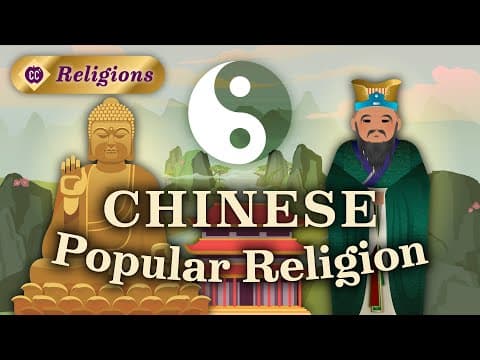
Confucianism, Buddhism, and Daoism: Chinese Popular Religion
CrashCourse
What's inside
5 thematic sections
Overview
You will be able to explain why conventional Western categories of “religion” fail to map neatly onto Chinese life, and how lived practice differs from formal identification. You will understand how Confucianism became embedded in the state and daily culture, and why its status as “religion” is debated. You will also grasp how Daoism conceives ultimate reality, cultivates life through practice and ritual, and how all three teachings converge in what scholars call Chinese popular religion.
Categories with Confucianism, Buddhism, and Daoism: Chinese Popular Religion
Confucianism, Buddhism, and Daoism: Chinese Popular Religion
Notes with 5 Sections
In China, many people engage in religious beliefs and practices without identifying as belonging to a formal religion.
The transcript states that while about forty percent believe in a deity and one-quarter burn incense regularly, only one-tenth say they are part of a religion, and many find the question "What’s your religion?" strange, indicating a disconnect between practice/belief and formal religious identification.
About forty percent of Chinese adults say they believe in a religious figure, god, or deity… but only one-tenth say they’re part of a religion.
The Western category of “religion” does not map neatly onto Chinese culture, where religious identity is not exclusive and the Three Teachings function as complementary rather than competing systems.
Although China officially recognizes five regulated religions, most people do not identify exclusively with one; instead, Buddhism, Confucianism, and Daoism operate together, shaping the Lunar Calendar, holidays, society, and culture in an intertwined way.
The Three Teachings aren’t viewed as rivals but as complements to each other.
There is a distinction between academic classifications of religion and the lived experience of religious practice.
While scholars label and categorize traditions, practitioners often do not identify with those formal categories, highlighting a gap between analytical frameworks and everyday religious self-understanding.
It’s another reminder that there’s a difference between the academic understanding or classification of religion and the lived experience of religion.
Chinese popular religion is a broad scholarly term for widely practiced beliefs and rituals—indigenous, blended, or unofficial—not typically claimed as a formal identity by participants.
Activities like burning incense, believing in deities, making offerings to ghosts, or venerating ancestors are categorized academically as “Chinese popular religion,” even though most practitioners would not label themselves as belonging to that religion.
Many scholars would say they are participating in Chinese popular religion, a broad term for beliefs and practices that exist in the general population.
Chinese religious life often blends Confucianism, Buddhism, and Daoism without requiring exclusive commitment to any one tradition.
Practices like the Ghost Festival show elements from all three traditions, yet participants rarely identify strictly as Confucian, Buddhist, or Daoist, reflecting a cultural pattern of connection without exclusive affiliation.
It’s not a contradiction to be connected to all three but committed to none.
In these notes
- Thematic Sections
Add these18concepts to your library
 Notion, Obsidian or Markdown.