The Biggest Myth In Education
Veritasium
What's inside
5 thematic sections
Overview
You will be able to assess whether matching teaching to “learning styles” actually improves learning, and how that claim should be properly tested. You will understand why the theory feels intuitively true yet fails experimentally, what actually drives learning instead, and how confirmation bias and search behavior sustain the myth.
Categories with The Biggest Myth In Education
The Biggest Myth In Education
Notes with 5 Sections
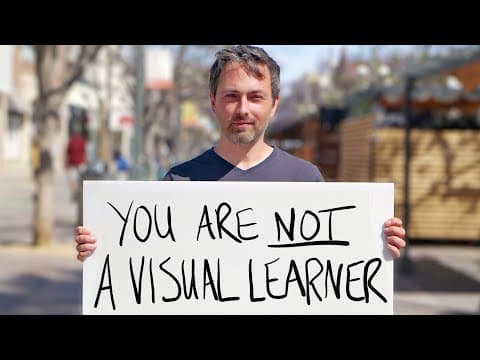
The learning styles hypothesis claims that individuals learn better when information is presented in their preferred modality (e.g., visual, auditory, reading-writing, or kinesthetic).
The idea is that each person has a specific "learning style," and if teaching matches that style, learning outcomes will improve; this belief underpins practices like identifying students’ styles and tailoring instruction accordingly.
If information is presented in accordance with the learning style, well, then they'll learn better.
The popularity of learning styles is partly driven by the intuitive appeal that people are unique and differ in abilities, so they might learn differently.
The transcript argues that because we observe differences in spatial reasoning, listening comprehension, reading ability, and manual skill, it feels natural to conclude that learning must also differ by preferred modality.
Learning styles make intuitive sense because we know everyone is different.
For learning styles to be educationally useful, teachers must both identify each student’s style and match instruction to it.
The transcript states that applying the theory requires two steps: diagnosing each student’s learning style and then delivering lessons in a way that aligns with that diagnosed style.
To take advantage of learning styles then teachers need to do two things: first, identify the learning style of each of their students; and second, teach each student in accordance with their learning style.
The VARK model originated from an attempt to explain why some teachers reach certain students and others do not, not from evidence that learners cluster into natural categories.
Neil Fleming created VARK after observing that excellent teachers sometimes failed to reach learners and poor teachers sometimes succeeded, and he described modal preferences as having explanatory ‘magic,’ without citing studies demonstrating four natural learner groups.
There was no study that revealed students naturally cluster into four distinct groups — just some magic that might explain why some teachers can reach students while others can't.
In these notes
- Thematic Sections
Add these18concepts to your library
 Notion, Obsidian or Markdown.