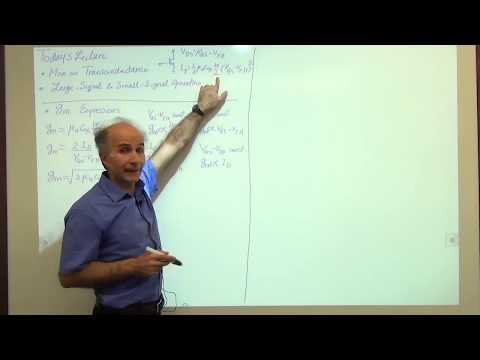
Razavi Electronics 1, Lec 33, Large-Signal & Small-Signal Operation
Behzad Razavi (Long Kong)
Save 54 minutes
Original Video
Summiz
67 min
Original13 min
with Summiz5x
faster learning efficiencyBrief summary
Lecture 33 of Razavi Electronics breaks down large-signal vs. small-signal operation in MOSFETs, showing how biasing, transconductance, and device sizing affect current flow, signal amplification, and linear modeling in analog circuit design.
 Notion, Obsidian or Markdown.