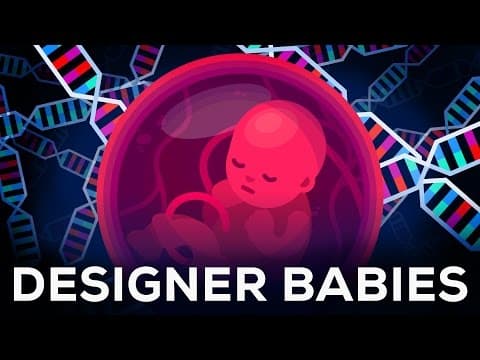
Genetic Engineering Will Change Everything Forever – CRISPR
Kurzgesagt – In a Nutshell
What's inside
5 thematic sections
Overview
You will understand how humanity moved from blind breeding to programmable gene editing, and why CRISPR marks a qualitative leap in power, speed, and accessibility. You will be able to reason about what becomes possible—from curing genetic disease to altering the human germline—and what risks emerge when technical capacity outruns biological understanding and political restraint. Ultimately, you’ll grasp why genetic engineering forces a decision: prohibition, passive drift, or conscious participation in directing evolution itself.
Categories with Genetic Engineering Will Change Everything Forever – CRISPR
Genetic Engineering Will Change Everything Forever – CRISPR
Notes with 5 Sections
The discovery of DNA revealed that life operates through a molecular code that determines growth, development, function, and reproduction.
DNA is described as a complex molecule whose structure encodes information using four nucleotides; changing the structure changes the instructions carried, meaning life can be altered by modifying this code.
A complex molecule that guides all living things’ growth, development, function and reproduction.
Before understanding DNA, humans shaped life through selective breeding, strengthening useful traits without fully knowing the underlying mechanism.
For thousands of years, humans enhanced desirable characteristics in plants and animals by choosing which individuals reproduced, even though they did not understand how traits were biologically transmitted.
Through selective breeding, we strengthened useful traits in plants and animals.
Early genetic engineering relied on inducing random mutations with radiation in hopes of producing beneficial changes by chance.
In the 1960s, scientists bombarded plants with radiation to trigger random changes in genetic code, aiming for lucky mutations that resulted in useful traits.
In the 1960s, scientists used radiation to bombard plants and trigger random mutations in the genetic code.
By the 1970s, scientists could insert specific DNA fragments into organisms, enabling deliberate genetic modification for research, medicine, agriculture, and other uses.
Unlike random mutation, inserting DNA fragments allowed targeted changes in bacteria, plants, and animals, leading to applications such as research tools and medical production.
In the 70s, scientists inserted DNA fragments into bacteria, plants and animals.
Genetically engineered organisms have been commercialized and used to produce valuable substances like insulin, growth hormone, and clotting factors.
After patents in the 1980s, engineered microorganisms were used to manufacture important chemicals and life-saving medical substances that previously had to be extracted from animal organs.
Today we produce many chemicals this way, like life-saving clotting factors, growth hormone and insulin.
Genetic engineering has extended to food and even humans, including tomatoes engineered for longer shelf life and babies with DNA from three parents.
Examples include the Flavr Savr tomato with an added gene to slow rotting, and medical interventions producing children carrying genetic information from three individuals to treat infertility.
Flavr Savr tomato added an extra gene to slow the accumulation of a rotting enzyme, giving it a longer shelf life.
Despite impressive results, early gene editing techniques were expensive, complex, and time-consuming.
All the described achievements occurred under conditions where genetic modification required significant resources and technical difficulty, limiting accessibility and speed.
Before this, gene editing was very expensive, complex, and time-consuming.
In these notes
- Thematic Sections
Add these28concepts to your library
 Notion, Obsidian or Markdown.